
How Much Does a Dispensary Website Cost in 2026?
Short answer: anywhere from a few hundred dollars a year to well over $100,000.
That range is so wide it's almost useless. So let me give you the real picture, the numbers we actually see across the country, and the part most operators get wrong.
I've built websites, mobile apps, kiosks, and e-commerce systems for cannabis retailers in multiple states. After all of that, here's my honest conclusion: most dispensaries are asking the wrong question.
It isn't "how much should a dispensary website cost." It's "what should a dispensary website actually do." Because in 2026, your website isn't a digital brochure. It's the front door to your business.
You probably want a real number before reading the rest. Reasonable.
What a Dispensary Website Actually Costs
Most operators believe they only get two choices: go cheap and live with the problems, or pay for an expensive custom build. The real market has more to it than that.
The Cheap End
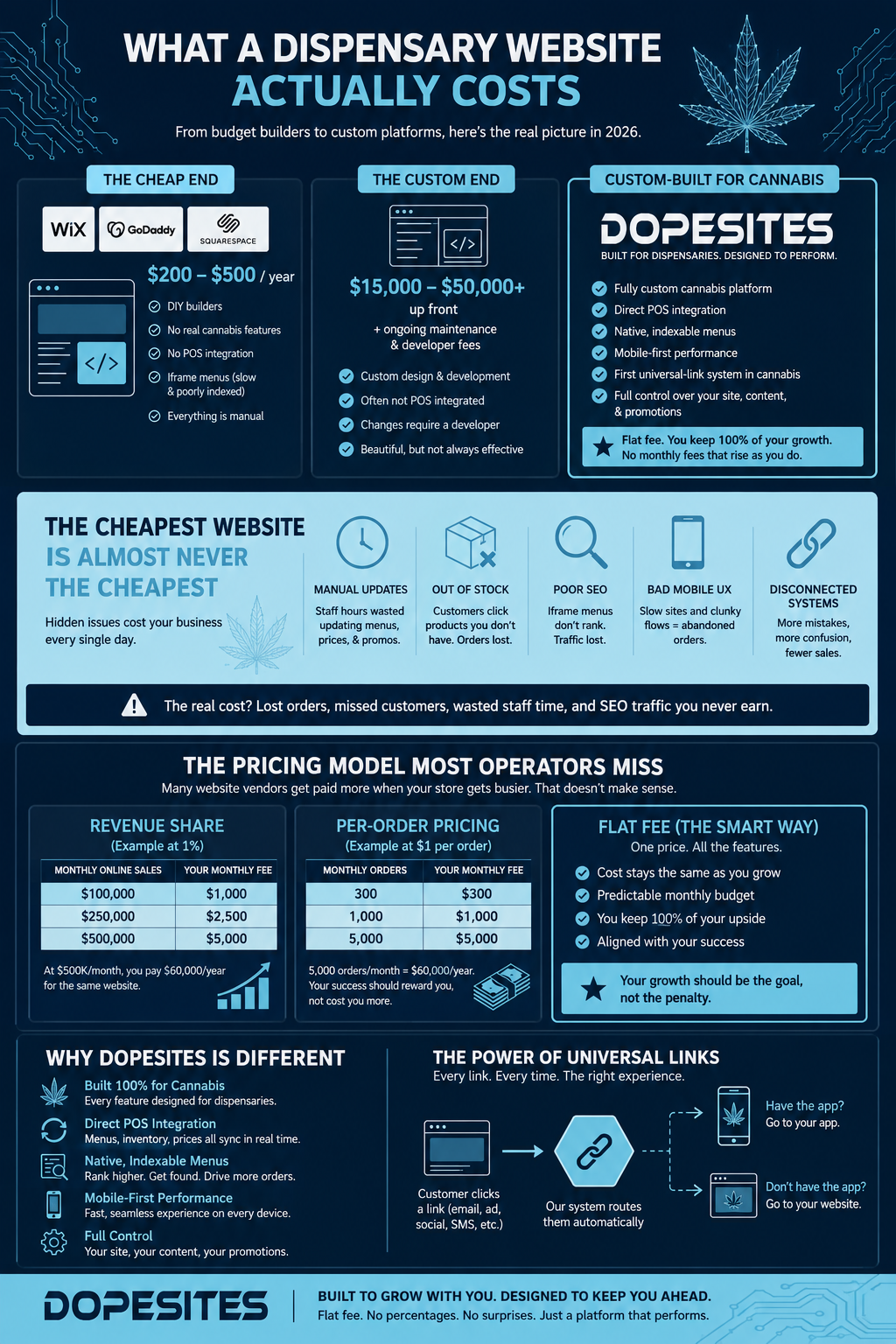
Wix, GoDaddy, Squarespace, and similar DIY builders. You're looking at $200 to $500 a year, sometimes less. The site is yours to build and maintain. No real cannabis features, no POS integration, and almost always an iframe menu embedded from a third party. That iframe is the quiet killer. Google struggles to index it, it tends to load slow, and it feels bolted on to the customer. Everything else is manual.
The Custom End
Agency or freelance custom builds run anywhere from $15,000 to $50,000 and up front, plus ongoing maintenance and developer fees every time you want to change something. Some of these are beautiful. Many still don't move the needle on orders. More on that in a minute.
Custom-Built for Cannabis
DopeSites isn't a template, and it isn't the budget option. It's a fully custom cannabis platform, built for dispensaries from the ground up. Direct POS integration, native indexable menus, mobile-first performance, and full control over your site, content, and promotions. We also built the first universal-link system in cannabis, which routes every customer to your mobile app if they have it and your website if they don't. More on that below.
You'll notice we don't print a price here, and that's on purpose. A single shop and a twelve-store operator have completely different needs, so quoting one number on a web page would be misleading to both. We scope every build to your footprint, your integrations, and what you actually want the platform to do. What we'll say plainly: it comes in well under what an agency charges for a custom build of the same caliber, and it's a flat fee, so the cost never climbs just because you start selling more. More on why that matters below.
The way you get your real number is a short demo. We walk your current site, show you exactly where it's leaking orders, and price the build to your business.
This is where price stops being the real story anyway.
The Cheapest Website Is Almost Never the Cheapest
When we audit dispensary sites, the problem usually isn't how they look. It's what they're quietly costing the business every single day.
A few real examples.
One dispensary came to us on a basic Wix site with a manually updated menu. Every time inventory changed, a staff member had to update products, prices, and promotions by hand. They were burning several hours a week maintaining information that already lived in their POS. Worse, customers kept clicking products that were already sold out. Frustrated buyers, abandoned carts, and phone calls that never should have happened.
Another operator had spent heavily on a custom build. The site looked great. But the menu wasn't integrated with their POS, product pages weren't getting indexed by Google, and every change needed a developer. They'd spent tens of thousands of dollars and still couldn't answer one basic question: how many online orders is this website actually generating?
We've also seen stores where more than 80% of traffic came from phones, and the mobile experience was clearly an afterthought. Tiny buttons. Slow loads. Checkout flows that broke halfway through.
Nobody notices when a customer leaves. Analytics won't tell you someone gave up because the menu took too long to load. You only feel it when online ordering stays flat.
The most common thing we find is disconnected systems. Website in one place, menu in another, loyalty somewhere else, the app somewhere else. Every promotion becomes four separate updates. Every mistake creates customer confusion.
The real cost of a cheap website isn't the monthly fee. It's the lost orders, the bounced customers, the staff hours, and the SEO traffic you never earn. And the most expensive part of all? Most owners never see the customers who quietly chose another store.
The Pricing Model Most Operators Miss
Here's one of the strangest things in cannabis tech: a lot of website vendors get paid more when your store gets busier.
Think about that. You pay for marketing. You pay for SEO. You pay for loyalty, promotions, and staff. Then when online sales climb, your website vendor takes a bigger cut. I've never understood that model.
There are three common pricing structures.
Revenue Share
The vendor takes a percentage of online sales. Sounds fair at first. At 1% on $50,000 a month, that's only $500. But watch what happens as you grow:
- $100,000/month = $1,000/month
- $250,000/month = $2,500/month
- $500,000/month = $5,000/month
Nothing about the website changed. You just got more successful. A store doing $500K a month online pays $60,000 a year at 1%. That's enough to build several websites outright.
Per-Order Pricing
Sneakier. Maybe $1 an order. A shop doing 300 orders a month barely notices. A shop doing 5,000 absolutely does. At $1 per order, 5,000 orders a month is $60,000 a year. Again, the website isn't doing more work. You're just selling more.
Flat Fee
This is what we chose for DopeSites, and the reasoning is simple. Your website vendor and your store shouldn't have opposing incentives. If you double online sales, that should be a win for you, not an excuse for a bigger software bill.
Run the comparison on five stores doing $1 million a month online combined. On a 1% revenue share, that's $120,000 a year. Push to $2 million a month and the bill hits $240,000 a year. The website didn't get any better. You just sold more cannabis. A flat fee doesn't move. You sell more, you keep more.
If your provider gets dramatically more expensive every time you grow, you're not buying software. You're giving away a piece of your own future.
So Is It Worth It? The ROI Math
The question isn't whether you can afford a $5,000 build and $500 a month. It's whether you can afford not to.
Most operators compare a website against its monthly fee. That's the wrong comparison. The right one is against the revenue and labor it touches every day.
Simple math. Say your average online order is $75. One extra online order per day is:
- $75 a day
- $2,250 a month
- $27,000 a year
One order. Per day. For most operators that single recovered order more than pays for a serious website over a year, with room to spare. Two extra orders a day is $54,000 a year. Three is $81,000.
Most dispensaries don't need a website that performs miracles. They need one that stops losing opportunities. That's where the return comes from, and in our audits the leaks usually show up in four places.
Search Traffic That Never Arrives
Iframe menus and poorly structured pages that Google can't index. If search engines can't read your products, categories, and brands, you lose customers before they ever hit your site. Move to properly structured, indexable menus and that visibility comes back.
Mobile Visitors Who Never Convert
Most of your traffic is on phones. Every extra tap, slow load, or broken filter costs you orders at volume. Small improvements in mobile conversion produce real money because of how much mobile traffic flows through every month.
Manual Work That Shouldn't Exist
Once inventory, pricing, and menus sync automatically from your POS, the hours your team spends updating things by hand mostly disappear. For some operators the labor savings alone pay for the platform.
Bad Data
Items showing in stock that aren't. Wrong prices. Expired promos. Broken loyalty connections. Every one of those kills trust and abandons orders.
The best ROI stories rarely start with a flashy redesign. They start with removing friction.
What's Changed in 2026
A few years ago, some features were premium. Today they're table stakes. A dispensary website should be mobile-first, connected to your POS, automatically synced with inventory and pricing, fast, SEO-friendly, tied into loyalty, connected to your app, and able to support kiosks and in-store ordering. None of that is luxury anymore. It's the baseline.
What's changed most isn't the website. It's the technology behind it. For years operators have lived with workarounds. Legacy platforms. Generic CMS systems. Iframe menus. Patchwork integrations. Separate tools for web, mobile, loyalty, and in-store. The result is always the same. More vendors, more complexity, more things breaking.
That's why we built DopeKit, our cannabis commerce platform and admin system built specifically for dispensaries. Not adapted from another industry. Not bolted onto a generic website builder. Built for cannabis from day one. It gives operators direct control over their sites, content, landing pages, promotions, menus, and SEO without the legacy workarounds that have become normal in this industry.
Most importantly, it works with the stack you already have. Whether you prefer direct POS integration, an existing e-commerce provider, your current loyalty system, a mobile app, or a future kiosk rollout, the goal isn't to force another migration. It's to make the whole ecosystem work together. Website, app, loyalty, kiosk, POS. One customer journey.
We took that further than anyone else in this space. DopeSites is the first platform in cannabis to ship universal links. When a customer taps one of your links, from a text, an email, a social post, or a QR code, they're routed straight into your mobile app if they have it installed, and to your website if they don't. No dead ends, no "open in browser" friction, no asking the customer to figure out where to go. The same link works everywhere, and it quietly pulls app users back into the app, where they convert and reorder fastest. Most of cannabis still treats web and app as two separate worlds. We connect them.
That's where cannabis retail is going. Not separate systems. Connected ones.
The Biggest Myth in Cannabis Tech
The myth I'd most like to kill: the cheapest website saves money.
It usually doesn't. And neither does the most expensive one. Price alone tells you almost nothing.
I've watched dispensaries spend very little and pay for it later in lost orders, weak SEO, and wasted hours. I've watched others drop tens of thousands on a custom build that looked beautiful and produced nothing measurable.
The goal isn't cheap. The goal isn't expensive. The goal is ROI. Before you buy, ask yourself a handful of questions. Will this increase orders? Will it cut manual work? Will it improve the customer experience? Will it support future growth? Will it work with the systems I already use? Can I actually measure the results?
If the answers are yes, the investment makes sense almost regardless of the sticker price. If they're no, the price tag doesn't matter.
My Bottom Line
If I owned a dispensary today, I wouldn't shop for a website. I'd shop for a revenue platform.
I'd want direct integration with my existing systems, a mobile-first experience, real SEO foundations, one unified experience across web, app, and in-store, the ability to make changes without waiting on a developer, and pricing that doesn't climb every time I sell more.
Most operators spend months comparing website costs. Very few spend any time calculating the cost of a website that underperforms. That's usually where the real money gets lost.
The best website isn't the cheapest one. It's the one that quietly helps your business grow every day while staying out of your way. That's what dispensaries should be buying in 2026.
See What Your Site Is Costing You
Want to know what your current site is quietly costing you, and what a platform built for your business would actually run? Book a demo. We'll walk your current site, show you exactly where orders are leaking, and give you a real number priced to your footprint. No flat menu, no guesswork.